
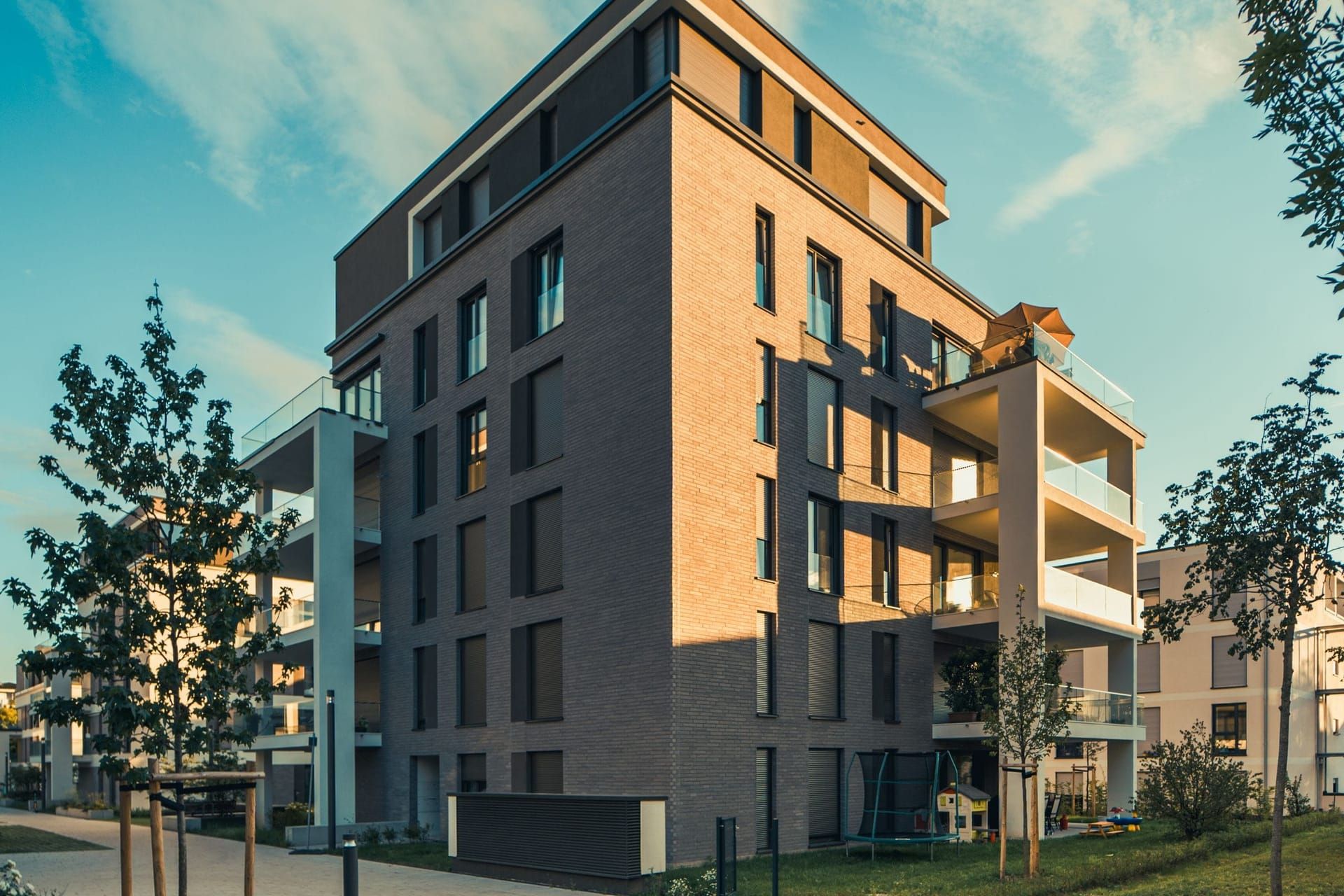
BY SIZE
Multifamily Financing by Building Size
The optimal loan product changes dramatically based on unit count. A 5-unit walk-up and a 150-unit garden complex use completely different financing paths.
Small Multifamily (5–20 Units)
Walk-ups, small apartment buildingsThe entry point for most apartment investors. DSCR loans are common here — no personal income docs, qualification based on rent roll. Portfolio banks and credit unions also compete. Down payment: 20–25% for a DSCR loan. Many investors start here and 1031 exchange up.
Mid-Size Apartment (20–50 Units)
Garden-style, low-rise complexesEnough units for meaningful economies of scale. On-site management becomes justified. Bank and CMBS options open up alongside DSCR. Agency small-loan programs (Fannie Mae Small Mortgage Loans, Freddie Mac Small Balance Loans) are open to buildings of five or more units; Freddie Mac’s targets loans of $1 million to $7.5 million.
Large Apartment (50+ Units)
Institutional-grade, agency-eligibleFull agency financing (Fannie Mae DUS, Freddie Mac Optigo): 5–30 year terms, up to 30-year amortization, and non-recourse execution with standard carve-outs for bad acts such as fraud and bankruptcy. HUD 223(f) loans can run up to 35 years. Life company and CMBS also compete. Professional management required.
FINANCING OPTIONS
Loan Options for Multifamily Properties
Apartment buildings have a financing source most other property types lack: agency lending from Fannie Mae and Freddie Mac, plus FHA insurance under HUD Section 223(f).
DSCR Loan
No personal income docsCommon for 5–20 unit buildings. No tax returns. Qualification based on rent roll. Close in 21–35 days. Scale your portfolio without affecting personal DTI.
Agency (Fannie/Freddie)
Non-recourse option, up to 30-year amortizationFannie Mae and Freddie Mac loans made through approved lenders: non-recourse execution with standard carve-outs for bad acts, fixed or variable rates, up to 30-year amortization. Only for residential rental property (not office, retail, or industrial). For stabilized properties — Fannie Mae DUS typically looks for 90% occupancy for the 90 days before funding.
Conventional Bank
Local banks, relationship pricingFull documentation. Community banks may offer relationship pricing and flexibility on unit count. Good for borrowers with existing banking relationships.
CMBS / Bridge
Large deals, value-add, repositioningCMBS for large stabilized complexes. Bridge for value-add deals: acquire, renovate units, raise rents, then refinance into agency or permanent. Non-recourse available.
Typical ranges, updated September 2026. Your terms depend on the property, the borrower and the lender.
KEY METRICS
What Lenders Evaluate for Apartment Loans
These are the core metrics apartment lenders evaluate.
LOAN SIZING
Example: How Much Can You Borrow on an Apartment Building?
Apartment lenders size the loan by the property’s income, not just its price. The loan is the lower of two limits: a loan-to-value cap and the largest loan whose payment the net operating income covers at the lender’s minimum DSCR. At rates like the example below, the DSCR limit can bind first — so buyers may need to put down more than the LTV cap alone suggests.
Example: a 20-unit building priced at $3,000,000 with $180,000 of annual NOI (a 6% cap rate). Assumptions for illustration only: 6.5% interest rate, 30-year amortization, lender limits of 75% LTV and 1.25x minimum DSCR.
To borrow closer to 75% LTV on this building, the NOI would need to be about $213,000, or the rate lower. Run your own numbers with the max loan calculator (all three limits at once) or the DSCR calculator, and check your per-unit price with the price per unit calculator. The loan checklist lists the documents apartment lenders ask for, and the commercial real estate loan application starts a comparison with no hard credit pull.
Sources: Fannie Mae Multifamily — financing for properties with five or more units through DUS lenders (multifamily.fanniemae.com/about-multifamily/our-work); Freddie Mac Multifamily — loans on properties with five or more units through Optigo lenders (mf.freddiemac.com/borrowers); HUD — Section 223(f) mortgage insurance for the purchase or refinance of existing multifamily rental housing (hud.gov/hud-partners/multifamily-programs).
THE PROCESS
How Multifamily Financing Works
Share Your Deal
Unit count, rent roll, unit mix (1BR/2BR/3BR), purchase price or estimated value, current occupancy, and your investment strategy (buy-and-hold vs value-add).
Submit to BestLoanUSA
Single application. No hard credit pull. We assess your deal across DSCR, bank, agency, and CMBS options based on property size and stabilization.
Advisor Review
Dedicated advisor analyzes your rent roll, unit economics, market comps, and investment timeline to recommend the optimal loan structure. Small buildings often go DSCR; agency small-loan programs start at five units.
Lender Matching
We submit to multifamily-specialist lenders. For agency deals, we connect with Fannie/Freddie approved sellers. You compare the term sheets that come back.
Underwriting & Appraisal
Multifamily appraisal with income approach. Provide rent roll, T-12 operating statement, unit-level lease abstracts, and property condition report.
Close & Fund
DSCR: 21–35 days. Bank: 30–45 days. Agency: 45–75 days. CMBS: 45–90 days. Bridge: 14–30 days.
Free tools
Run the numbers
The same metrics a lender checks — free, instant, no signup. Each result links straight into an application.
- Price Per Unit Calculator Calculate per-unit pricing for multifamily properties. Compare apartment buildings on a per-door basis and estimate property value from target per-unit pricing.
- GRM Calculator Calculate Gross Rent Multiplier to quickly compare property values relative to gross rental income. A fast screening tool for CRE investment opportunities.
- DSCR Calculator Calculate your Debt Service Coverage Ratio instantly. See if your property qualifies for CRE financing and which loan programs are available to you.
FAQ
Frequently Asked Questions
How do apartment complex loans work?
An apartment complex loan is a commercial mortgage secured by the building. The lender sizes it from the property’s rent roll and net operating income: the loan is the lower of a loan-to-value cap and the amount the NOI can repay at a minimum DSCR (often 1.20–1.25x for bank and agency loans). Bank loans usually have a 5–10 yr term with 20–30 yr amortization and a balloon at maturity; agency and HUD-insured loans can run longer. Buildings with five or more units are financed this way — one to four units use residential mortgages.
Who lends on apartment buildings?
Six main groups: local and regional banks and credit unions; Fannie Mae DUS lenders and Freddie Mac Optigo lenders (agency loans, five or more units); FHA-insured lenders under HUD Section 223(f) for buying or refinancing existing apartment properties; life insurance companies for low-leverage loans on stabilized buildings; CMBS lenders for larger loans; and DSCR and bridge lenders for smaller or value-add buildings. BestLoanUSA is not a lender — we compare offers from 30+ lenders across these groups, with no hard credit pull to start.
How much down payment do you need for an apartment building?
The LTV cap sets the minimum — 25–35% for a typical bank loan and 20–25% for a DSCR loan — but the property’s income often requires more. In the example above, a $3,000,000 building with $180,000 NOI qualifies for $1,898,000 at a 6.5% example rate and 1.25x DSCR, so the buyer needs about 37% down, not 25%. Higher NOI or a lower rate closes that gap.
What documents do lenders need for a commercial loan on an apartment building?
Expect a current rent roll, the trailing 12-month (T-12) operating statement, the purchase contract or current loan payoff statement, a schedule of real estate you own, a personal financial statement, and entity documents. Bank loans also ask for recent personal (and, where applicable, business) tax returns; DSCR loans qualify on the property’s income and skip personal income documents. The lender orders the appraisal and third-party reports. The BestLoanUSA loan checklist builds the list for your deal.
At what unit count does a property become "commercial" multifamily?
Properties with 5 or more residential units are classified as commercial multifamily and require commercial financing. 1–4 unit properties are residential and can use conventional residential mortgages (Fannie Mae residential, FHA). The financing options, rates, and underwriting process are fundamentally different above and below the 5-unit threshold.
What is agency lending and why is it special for apartments?
Agency lending refers to loans originated through Fannie Mae and Freddie Mac multifamily programs. Typical terms: 6.25–7.25%, 5–30 year terms with up to 30-year amortization, up to 80% LTV, and non-recourse execution — you’re not personally liable except for standard carve-outs such as fraud and bankruptcy. The programs finance residential rental property, not office, retail, or industrial.
Can I buy a 5-unit building with no income verification?
Yes. DSCR loans qualify you based on the property’s rent roll, not your personal income. If the building’s NOI covers at least 1.0–1.25x of the annual debt service, you qualify without providing tax returns, W-2s, or pay stubs. It is a common path for investors building a portfolio of small apartment buildings.
What is a value-add multifamily deal?
Value-add means acquiring a property below market value, renovating units (new kitchens, bathrooms, flooring, appliances), raising rents to market rates, and refinancing at the higher appraised value. Bridge loans fund the acquisition and renovation. Once stabilized (85–90%+ occupancy) with market rents, you can refinance into permanent or agency financing, typically at a lower rate than the bridge loan.
How do lenders analyze a rent roll?
Lenders examine current rents vs market comparables, lease expiration dates, tenant payment history, vacancy trends, and unit mix. They calculate effective gross income (total rent minus vacancy and concessions), subtract operating expenses, and arrive at NOI. The rent roll is the foundation of multifamily underwriting — a clean, well-documented rent roll helps underwriting move faster.
Can I use a 1031 exchange to buy an apartment building?
Yes. Many investors use a 1031 exchange to move into multifamily. Sell a smaller investment property, defer capital gains taxes, and reinvest into a larger apartment building. The exchange must follow IRS rules: identify replacement property within 45 days and close within 180 days. Many investors 1031 from single-family rentals or small multifamily into larger apartments.
Related on BestLoanUSA
Financing options
All loans →- Investment Property An investment property loan finances a building you own to rent out — multifamily, retail, office, industrial or mixed-use — and is underwritten mainly on the property’s income. Bank, DSCR, CMBS and agency lenders typically lend up to 75–80% of value at about 6.5–8.75%. CMBSDSCR
- CMBS Loans A CMBS loan (conduit loan) is a fixed-rate commercial mortgage that a lender pools with others and sells to bond investors. It suits stabilized office, retail, industrial, multifamily and hotel properties from about $2M, with 5–10 yr terms, up to 75% LTV, and no personal recourse beyond a carve-out guaranty. CMBSMultifamily
- What Is a CRE Loan? A commercial real estate loan is financing for income-producing or business-use property — offices, retail, industrial, multifamily (5+ units) — underwritten on the property’s cash flow and value as well as the borrower, not a home mortgage. CMBSMultifamily
- CRE Refinancing A commercial real estate refinance replaces your existing mortgage with a new loan — to lower the rate, replace a maturing balloon, move from floating to fixed, or take cash out. To refinance, check your current loan’s maturity and prepayment penalty, get the property appraised, show that its net operating income covers the new payment at the lender’s minimum DSCR, compare term sheets and close — the new lender pays off the old loan, usually in 30–60 days. Bank, SBA 504, CMBS and DSCR lenders price refinances at about 6.25–8.75%. CMBSDSCR
Guides & articles
All articles →- Commercial Real Estate Loans for Investors vs. Residential How commercial real estate loans differ from residential mortgages — underwriting on property income, loan types, terms and the lenders involved. CMBSMultifamily
- Multifamily Loans: How to Finance a 5+ Unit Apartment Building How financing changes at five units: multifamily loan types, how lenders underwrite an apartment building's income, and what they require. MultifamilyDSCR
- The 2026 CRE Maturity Wall: Refinancing a Loan That Comes Due $875 billion of commercial mortgages are scheduled to mature in 2026. How to size the gap when a low-rate loan refinances at today’s rates, and how to close it. MultifamilyRefinancing
Glossary
All terms →More calculators
All calculators →- Debt Yield Calculator Calculate Debt Yield (NOI ÷ Loan Amount) — the metric CMBS and institutional lenders prioritize over DSCR and LTV. Find your maximum loan amount based on target debt yield. CMBSDSCR
- Defeasance Calculator Estimate the total cost of defeasing your CMBS or conduit commercial loan. See the Treasury portfolio cost, transaction fees, and how it compares to yield maintenance. CMBSInterest rates
- NOI Calculator Calculate your property's Net Operating Income with a detailed income and expense breakdown. NOI drives your DSCR, cap rate, and property valuation. NOIDSCR